New acquisition
Who is Franz Grau?
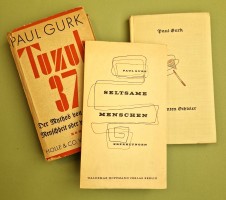
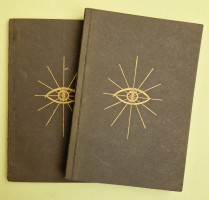
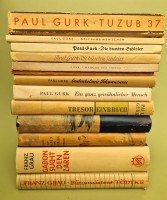
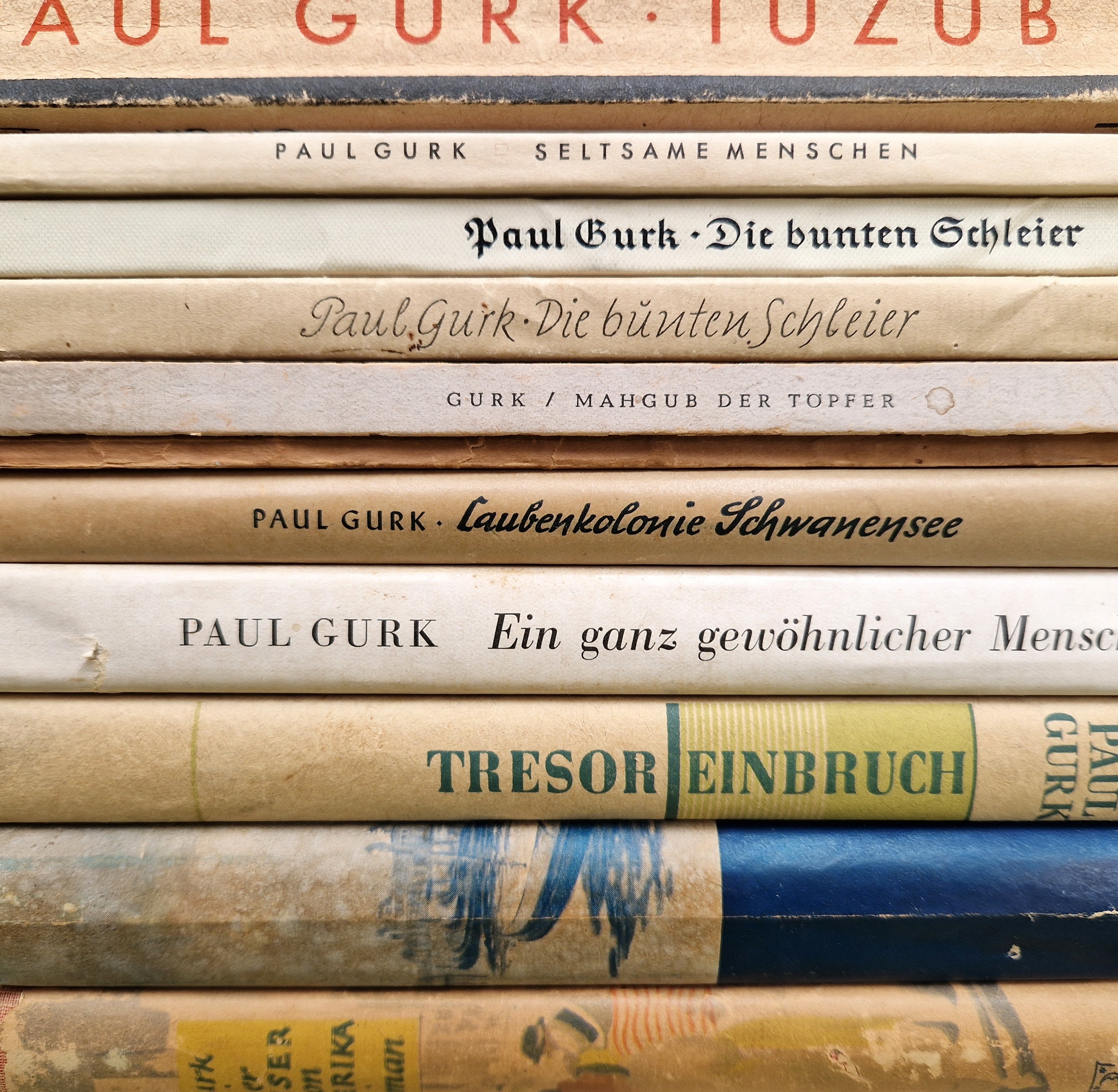
The museum library is delighted about its recent acquisition
of 32 books by the writer and painter Paul Gurk (1880-1953)
© Mitte Museum
“Who is the author who is old and young at the same time? Who lived in China and wrote down notes from non-existent wise people?” Who knew the language of the South Sea Islands without ever learning it? ? […] Who lives in the city, yet only sees landscapes and cloudscapes?
[…] So who was it that wrote ‘Serenissimus’? (The same person who two weeks ago swapped a watercolour for 10 eggs and a quarter of butter for the first time.)”
Those were the questions the publishing house Essener Verlagsanstalt asked the readers of the novel “Serenissimus” published in 1940 in the context of a competition. The first prize was an original painting by the “painter-poet Franz Grau”. Paul Gurk was behind this pseudonym. His life and work is closely linked to Berlin-Wedding, where the artist lived for a long time and where he was also buried. Now the museum library was in the lucky position to acquire 32 works by the artist – mostly first editions and a significant expansion of the existing Paul Gurk collection.
Paul Gurk was self-taught and largely educated himself how to write and paint. After he quit secondary school, Gurk worked his way up in various Berlin Magistrate offices, starting from the position of a clerk to becoming a civil servant. Yet his true passion was his art: His drawings have been preserved on the back covers of quite a number of files. When he received the Kleist Award in 1921, it meant his breakthrough as a writer. Gurk left the civil service, but was not as successful as he had hoped. To publish the novels “Serenissimus”, “Gapon sucht den Zaren” (Gapon’s search for the Tsar) and “Büroassistent Tödtke” (Clerk Tödtke) as the so-called “turning point trilogy” (1940/41) under the pseudonym Franz Grau in connection with the competition was an attempt to give the unlucky artist a fresh start.
Although Paul Gurk wrote more than forty plays and fifty novels, he was considered a forgotten writer even when he was still alive. His grave is on the Protestant Dom-Friedhof II, not far from his last flat on Afrikanische Straße 144b. During the Nazi dictatorship, his novel “Tresoreinbruch” (Safe burglary) was banned in 1935, but Gurk found an arrangement with the regime and was able to publish until the end of the war in spite of censorship. Among the newly acquired works for the Mitte Museum is also a rare edition of the novella “Die Traumstadt des Kaisers Kien-Lung” (City of Dreams of Emperor Kien-Lung) that was published as a volume of the Feldpost. During a fire following a bomb attack on Prague in 1943, a large part of the edition was destroyed.
To date, Paul Gurk’s works have still not been fully scientifically analyzed, and his legacy includes many novels and plays that were never printed. Even less well-known are the artist’s many watercolours and drawings, some of which are in the collection of the Mitte Museum as a partial legacy. We intend to change this with an exhibition about Paul Gurk that is currently under preparation at the Mitte Museum.
(Text: Jonas Hartmann)