History
The history of the Mitte Museum also narrates the history of the city. In 2001, in the course of the district reform that meant the merger of some districts in the former East and West of the city, in 2004 the Mitte Museum was the result of merging the former Mueum Mitte with the two local history museums Heimatmuseum Tiergarten and Heimatmuseum Wedding.
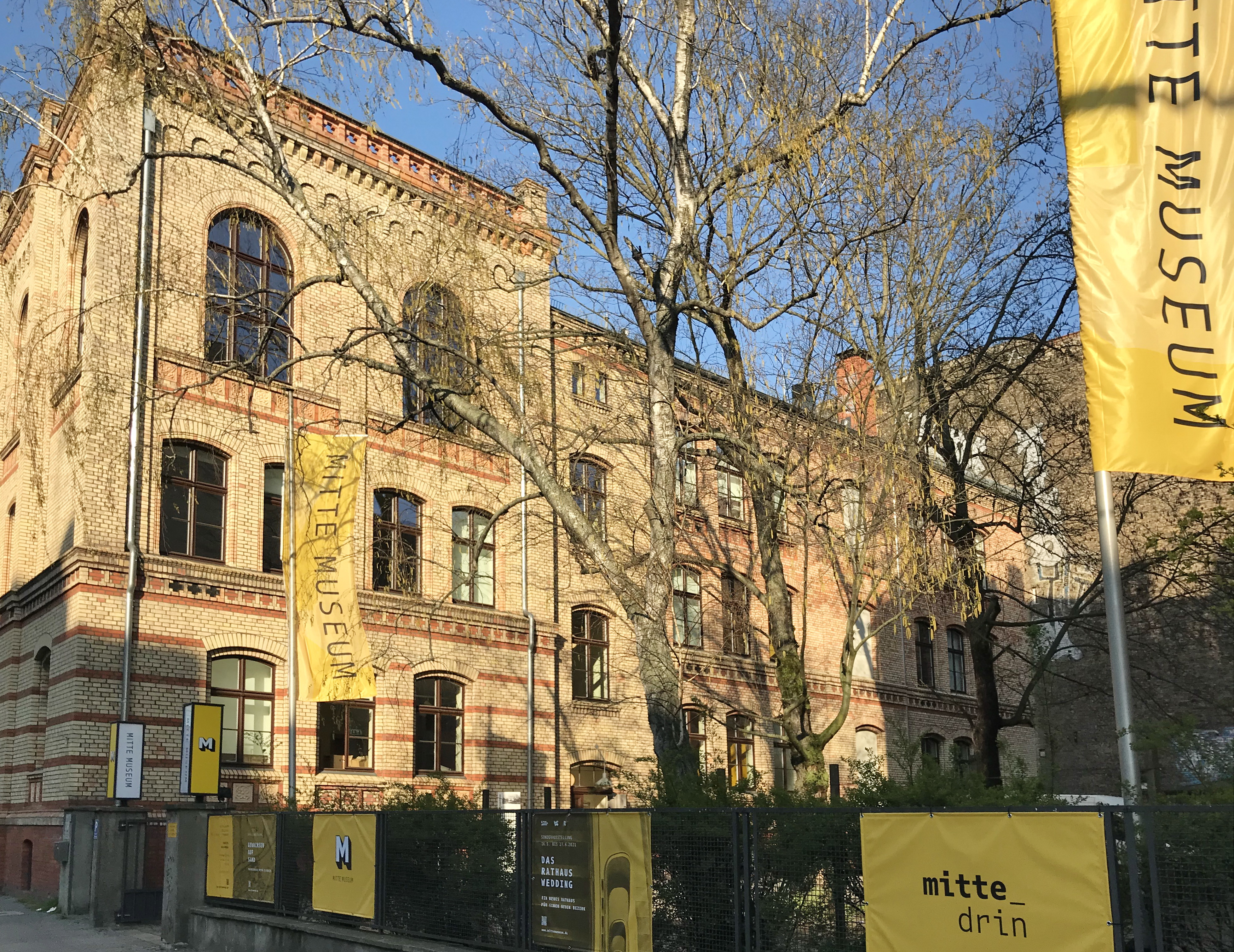
Heimatmuseum Mitte / Mitte Museum Berlin
The local history institution was founded in 1987 as the “Heimatgeschichtliches Kabinett” /local history cabinet) to mark the 750th anniversary of the then East Berlin district Mitte. A “lobby group local
history” that had already worked on local history themes for several
years initiated this step.
The exhibition spaces were on the ground floor of building No. 23 in
Sophienstraße that had been undergone a historicizing transformation to become an artisans’ lane for the city’s anniversary. Following the
reunification and the takeover of archive rooms on Torstraße, the name was changed to “Heimatmuseum Mitte” (Local History Museum Mitte)
in 1992. The museum remained in its original location until 1997.
With the move to the “Palais am Festungsgraben” (Palace on the Moat) behind the New Guardhouse on Unter den Linden came another name change to “Museum Mitte of Berlin”. This remained the name of the museum until the district merger and the following integration into the “Mitte Museum” of the enlarged district. In this location,
the “Mitte Museum on the Moat” showed various temporary exhibitions under different themes between 2004 and 2009.
Heimatmuseum Wedding
The local history museum Heimatmuseum Wedding developed from the previous local archive Wedding in 1989. Initial plans to found a
municipal local archive existed as early as the 1930s. In 1951, a big city festival accompanied by a historically themed exhibition was organized to celebrate the 700th anniversary of the documented reference to the village of Wedding. The curator of the exhibiiton and author of the
accompanying book was the teacher and local historian Bruno Stephan.
After the local archive Wedding opened its doors in 1952 – as a department of the district Office for Art and Culture – Bruno Stephan remained the director of this institution for 20 years. Right from the start, he
developed a local history collection. The main focus of his work was on guided tours, local history talks and individual information on local
history subjects.
Following the great success of an exhibition on the history of the
Wedding district in 1987 to mark the 750th anniversary of Berlin, the focus of the local archive Wedding was widened to turn it into a
regional history museum. In 1989, it was opened on Pankstraße 47 in
a festive ceremony in a school building from the 19th century that had been renovated in line with local regulations for the protection of
historical monuments as the “Heimatmuseum Wedding”. Since 2004, this has been the “Mitte Museum”.
Heimatmuseum Tiergarten
Like other district museums in former West Berlin, the local history
museum Tiergarten had its origins in a local history initiative.
As early as 1961, the working group “Arbeitskreis für die Geschichte des Bezirks Tiergarten e. V. (AGT” was founded with the goal to research and present the history of the local past. This had also led to the creation of a first historic collection. In 1984, the local archive “Heimatarchiv Tiergarten” opened its doors on Zwinglistraße 2 and was able to also
exhibit as the local museum “Heimatmuseum Tiergarten” in exhibition spaces in the Gebrüder-Grimm-Haus on Turmstr. 75 three years later.
A series of temporary exhibitions was developed into a permanent e
xhibition that remained open until the museum was closed in 2004.
The building on Pankstraße 47 was a parish school
Today’s residence of the Mitte Museum on Pankstraße 47 is a listed
building. It was built between 1865 and 1866 as the 32nd parish school, based on a plan by Municipal Councillor for Construction Adolf Gerstenberg and master-builder Petersen. It was the first public building in the former suburbs of Wedding and Gesundbrunnen after they had been incorporated in 1861. It is one of the oldest remaining school
buildings in Berlin.