A school surrounded by green space
The 32nd parish school and the Mitte Museum
The significantly enlarged copy of a watercolour by Wilhelm Streckfuss welcomes the Mitte Museum visitors in the rooms on the first floor. It shows the “Schulhaus auf dem Gesundbrunnen” (schoolhouse at Gesundbrunnen) in 1869.
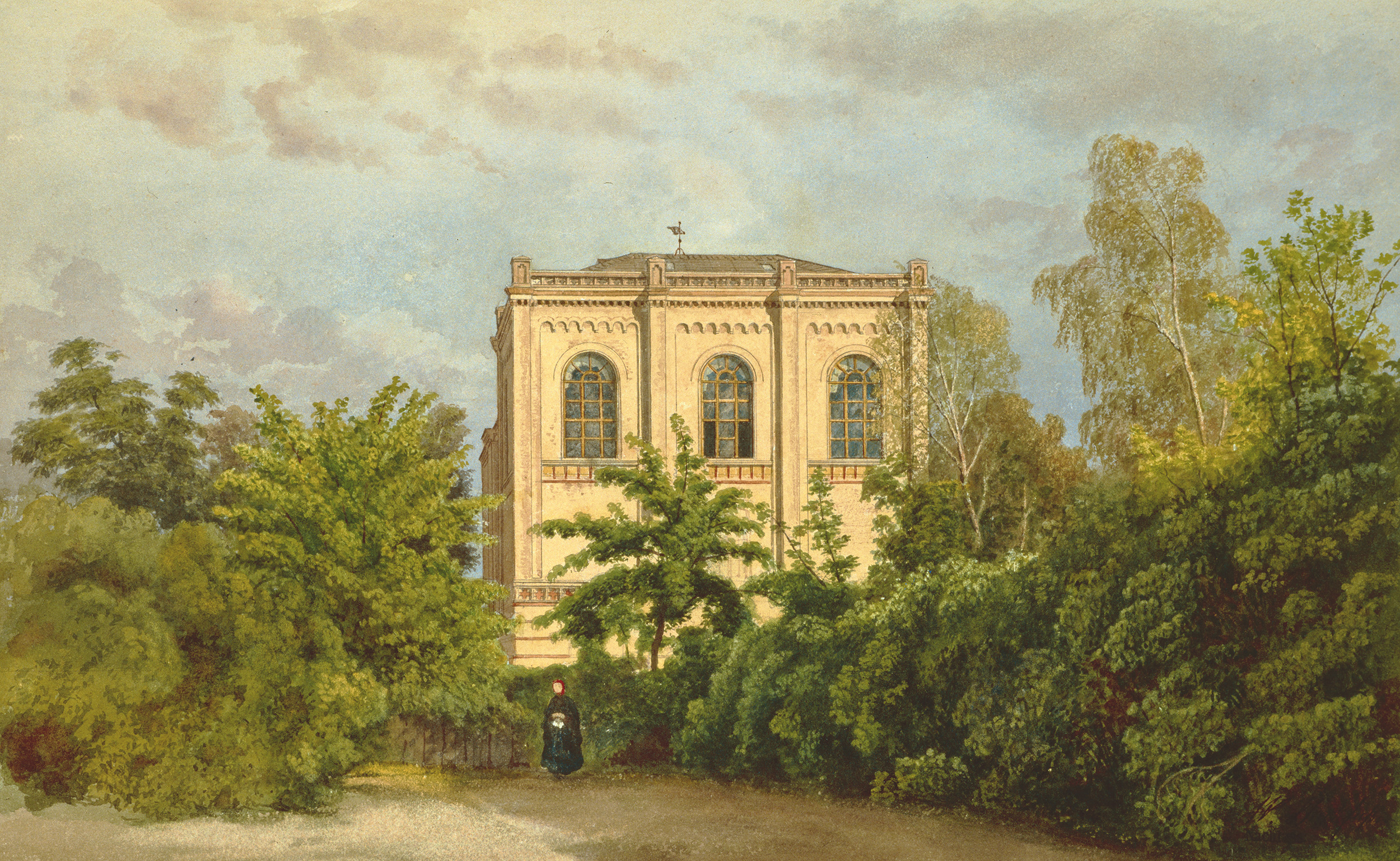
The Magistrate of Berlin had opened the building one year previously as the 26th parish school, following a two-year construction period.
Nowadays, it is one of the oldest remaining school buildings in Berlin. The school was built for 400 pupils, both girls and boys. The headteacher lived in the same house in a flat facing the street. In the flat
below, in the basement, was the flat of the school’s caretaker.
Wedding, Gesundbrunnen and Moabit had only been incorporated into the city of Berlin several years before, in 1861. The schoolhouse on
Pankstraße was the first building in the newly added districts that was financed by Berlin. Adolph Gerstenberg, Municipal Councillor for
Construction between 1861 and 1871, had developed the building, which was considered a model of its kind. This was because of the
elaborate positioning of the building between two schoolyards, the
layout of the rooms on the inside, the building materials, the fire safety precautions, the heating technology and the carefully considered colour scheme for the classrooms. Gerstenberg published the floor plan and the design of the rooms in the architectural journals of the time,
together with designs of his other schools that were realized concurrently.
The watercolour stems from the collection of the Stadtmuseum Berlin. The Mitte Museum is happy to be able to use the painting in its
exhibition and on its website.
The painter looks onto the cubic red-brick building from the pastorate garden on the opposite side of the street. This garden was behind the house of the pastor of the church of St. Paul. Pankstraße, running between the garden and the school, is rendered completely invisible by the vegetation. A lady wearing a red bonnet is in the garden together with the painter. We do not know who she is.
It is possible that Wilhelm Streckfuss (1817-1896) got to know the area around Gesundbrunnen and the pastorate of St. Paul through the family of the first pastor of the church, Christian Ferdinand Bellermann (1793-1863). Ferdinand Bellermann (1814-1889), a relative, studied Painting at the Berlin Academy of Arts with Streckfuss. Bellermann was predominantly known for his travels to Central America as a landscape painter. Alexander von Humboldt had encouraged him to embark on these journeys. With the works he created there, he followed the claim of the famous natural scientist to visually document Earth with all its phenomena and to put visual arts at the service of “Earth Science”,
a scientific discipline that was completely new at the time. This approach in turn attributed a new function to art. Streckfuss was also strictly committed to the imperative at the time of correctly reproducing in a painting what he saw. He was a master of this perspective. He taught this subject that was obligatory for all artists at that time and published a textbook about it in 1858.
The watercolour of the schoolhouse at Gesundbrunnen clearly shows that his sense of spatial representation was very confident. Not only
did the painter portray the building at the frontage of the modest, yet representative building with all its structural characteristics: the sunlit façade, the two-tone brickwork, the shaped bricks and wall projections, the Roman blinds behind the arched windows of the school’s assembly hall, and the weather vane on the roof. Moreover, he also includes the northern façade of the building pointing towards the schoolyard on the left at a very flat angle. His perspective of capturing the extremely
truncated side is highly accurate, allowing the viewer a very exact notion of the depth of the building. With the exception of the church of St. Paul on the opposite side of Pankstraße and the schoolhouse of the 26th parish school, there were no other buildings of a comparable size here. The public buildings would have markedly stood out between the one- and two-storey housing in the area, not yet very densely
populated at that time.
Seemingly, Streckfuss perceived the area around Gesundbrunnen as a friendly, almost enchanted place. Another one of his paintings also had its origins here, but it is only known through a black and white photo – the original is presumed to be lost. It shows a beautifully dressed couple that sets out on a walk through a yard gate on a summer day. During the summer months, the area around Gesundbrunnen was a popular destination for wealthy Berlin citizens and artists. Maybe Wilhelm Streckfuss was one of them. His brother Adolf Streckfuss (1823-1895) was a writer. He became mainly famous through his multi-volume work about the history of the city of Berlin: “Vom Fischerdorf zur Weltstadt” (From fishing village to metropolis) (1885).
The watercolour unites several aspects from the history of the area that have been largely forgotten nowadays: the role of the church of St. Paul as a sociopolitical structuring element in the sparsely populated
“suburbs” of Berlin; the close connection between the church and the schoolhouse, whose grounds had been bought by the parishioners with their own means; the incorporation of the area into the metropolitan area of Berlin in 1861; the function of the urban space at Gesundbrunnen as a recreational space that was used as such far beyond the middle of the 19th century. Since then, the district has changed significantly.
At the time, it was far away from the centre of Berlin. Yet it remained connected to the events in the royal seat through the people that lived in the district and those who visited it for recreation and relaxation.